
6.4 KiB
SUP
SUP (Signal Unified Push) is a privacy-preserving push notification system using Signal as transport
⚠️ Early Alpha: SUP is under rapid development. The Android app is being actively developed and the current version is not thoroughly tested. There are no stable releases yet. Use at your own risk.
SUP is a UnifiedPush distributor that routes push notifications through Signal, allowing you to receive app notifications without exposing unique network fingerprints to any network observers. All notification traffic appears as regular Signal messages.
Why?
Traditional push notification systems require persistent connections to specific servers, creating unique network fingerprints. Relying on traditional push notification services like Android's built-in FCM (Firebase Cloud Messaging) may also expose your notification metadata. SUP blends your notification traffic with regular Signal usage for better privacy.
SUP also includes an optional Proton Mail integration, allowing you to receive email notifications as Signal messages without exposing IMAP connections.
Note that you'll need to run SUP on your own server (either at home or on a VPS) since it uses your personal Signal and Proton Mail credentials. A Raspberry Pi, which is a small and affordable micro-computer, works perfectly for this, using minimal power (3-5W) while running SUP 24/7.
Setup
1. Install Android App (Optional)
An Android app is optionally available to connect UnifiedPush Android apps to the SUP server. It can also provide a better experience for displaying SUP-based notifications if the ENABLE_ANDROID_INTEGRATION environment variable is enabled on the server.
Download the latest APK from GitHub Releases.
Certificate Fingerprint:
0D:3C:99:15:0E:12:1A:DE:0D:AE:05:CB:16:46:5E:65:31:56:DC:D6:98:87:59:4E:79:B1:0D:AE:1E:56:F2:E8
2. Proton Mail Integration (Optional)
A Proton Mail Bridge is optionally available if you want to receive push notifications for incoming emails.
Note: The default Proton Mail Bridge image uses
shenxn/protonmail-bridge:buildwhich compiles from source and supports multiple architectures. For x86_64 systems, you can useshenxn/protonmail-bridge:latest(pre-built binary, smaller and faster). For ARM devices (Raspberry Pi), stick with:build.
To receive Proton Mail notifications via Signal:
- Initialize Proton Mail Bridge (one-time setup):
# Download docker-compose.yml
curl -L -O https://raw.githubusercontent.com/lone-cloud/sup/master/docker-compose.yml

docker compose run --rm protonmail-bridge init
- Login to Proton Mail Bridge:
- At the
>>>prompt, run:login - Enter your email
- Enter your password
- Enter your 2FA code
- Get IMAP credentials:
- Run:
info - Copy the Username and Password shown
- Run:
exitto quit
- Add credentials to .env:
# Add these to your .env file
PROTON_IMAP_USERNAME=bridge-username-from-info-command
PROTON_IMAP_PASSWORD=bridge-generated-password-from-info-command
- Start all services with Proton Mail:
docker compose --profile protonmail up -d
Your phone will now receive Signal notifications when Proton Mail receives new emails.
Note that the bridge will first need to sync all of your old emails before you can start getting new email notifications.
3. SUP Server integration
# Download docker-compose.yml
curl -L -O https://raw.githubusercontent.com/lone-cloud/sup/master/docker-compose.yml

# Download .env.example (optional)
curl -L -O https://raw.githubusercontent.com/lone-cloud/sup/master/server/.env.example

# Configure SUP server through environment variables (optional)
cp .env.example .env
nano .env

# Start SUP server
docker compose up -d

# Link your Signal account (one-time setup)
# Visit http://localhost:8080 and scan QR code with Signal app
Development
For local development, install Bun and signal-cli:
# Install Bun (use your package manager and this is a backup)
curl -fsSL https://bun.sh/install | bash

git clone https://github.com/lone-cloud/sup.git
cd sup

bun install
Then build and run with docker-compose.dev.yml:
docker compose --profile protonmail -f docker-compose.dev.yml up -d
or just the proton-bridge:
docker compose -f docker-compose.dev.yml up protonmail-bridge
Or run services directly with Bun:
bun install
bun --filter sup-server dev
Real-World Examples
Proton Mail Notifications
Receive instant Signal notifications when new emails arrive in your Proton Mail inbox. SUP monitors your Proton Mail account via the local Proton Mail Bridge and forwards email alerts through Signal, eliminating the need for persistent IMAP connections from your phone.
Home Assistant Alerts
Add a rest notification configuration (eg. add to configuration.yaml) to Home Assistant like:
notify:
  - platform: rest
    name: SUP
    resource: "http://<Your SUP server network IP>/Home Assistant"
    method: POST
    data:
      package: "io.homeassistant.companion.android"
    headers:
      Authorization: !secret sup_basic_auth
Add the Base64 version of your API_KEY environment variable secret to your secrets.yaml. This secret must be prepended by a colon and the simplest way to get this value is to run btoa(':<API_KEY>') in your browser's console.
sup_basic_auth: "Basic <Base64 Hash value>"
Reboot your Home Assistant system and you'll then be able to send Signal notifications to yourself by using this notify sup action.
Architecture
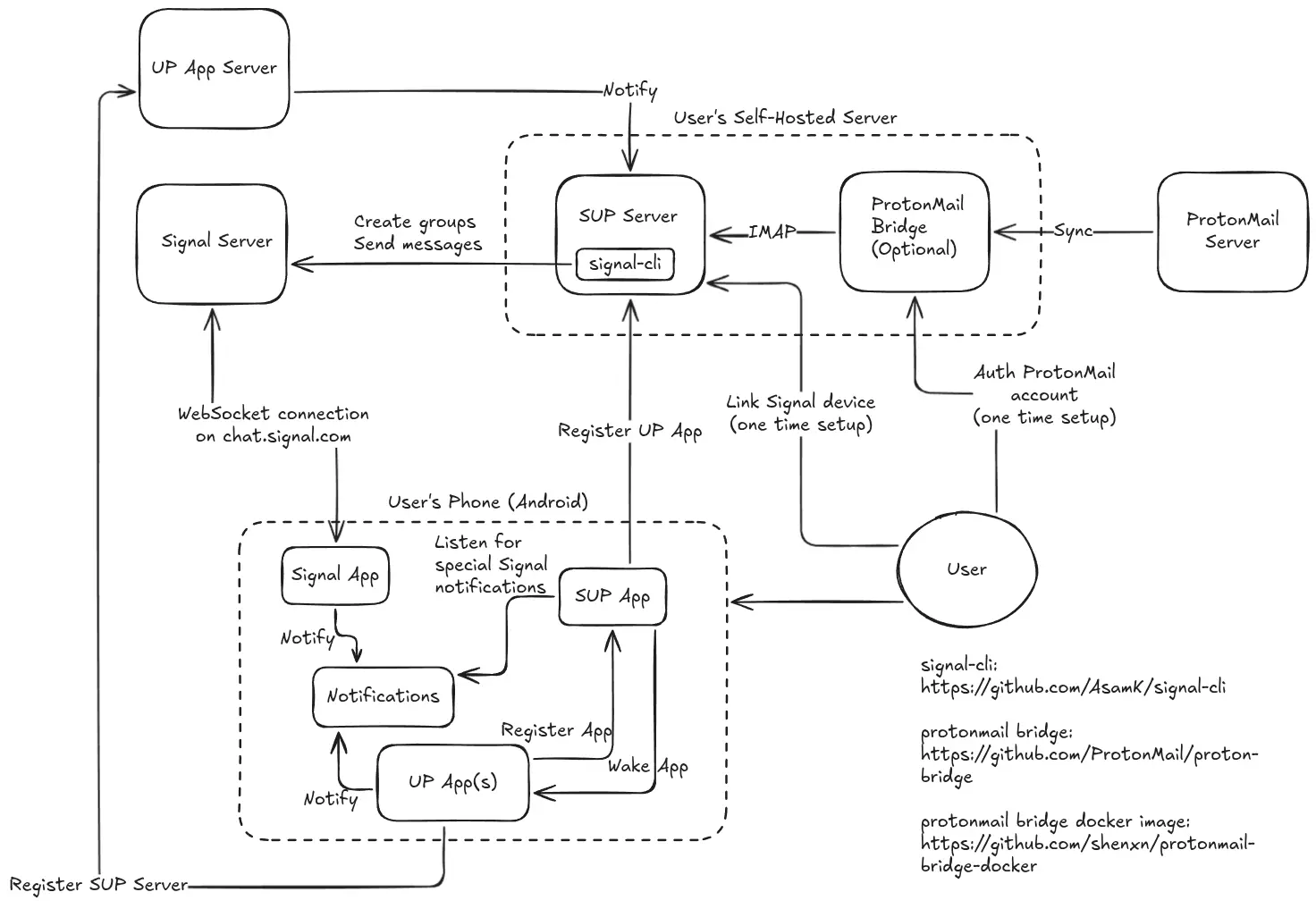
SUP consists of two services that MUST run together on the same machine:
- sup-server (Bun): Receives webhooks, sends Signal messages via signal-cli. Optional: monitors Proton Mail IMAP
- protonmail-bridge (Official Proton, optional): Decrypts Proton Mail emails, runs local IMAP server
All services communicate over a private Docker network with no external exposure except Signal protocol. Separating these services across multiple machines would expose plaintext IMAP traffic and compromise security.
Android App (Kotlin): Monitors Signal notifications, extracts UnifiedPush payloads, delivers to apps