Prism Icon # Prism **Notification gateway with email monitoring** [Setup](#setup) • [Integrations](#integrations) • [API](#api) • [Examples](#real-world-examples) • [Monitoring](#monitoring)
Route notifications to Signal, Telegram, or WebPush via webhooks or Proton Mail monitoring. Android companion app: [prism-android](https://github.com/lone-cloud/prism-android)

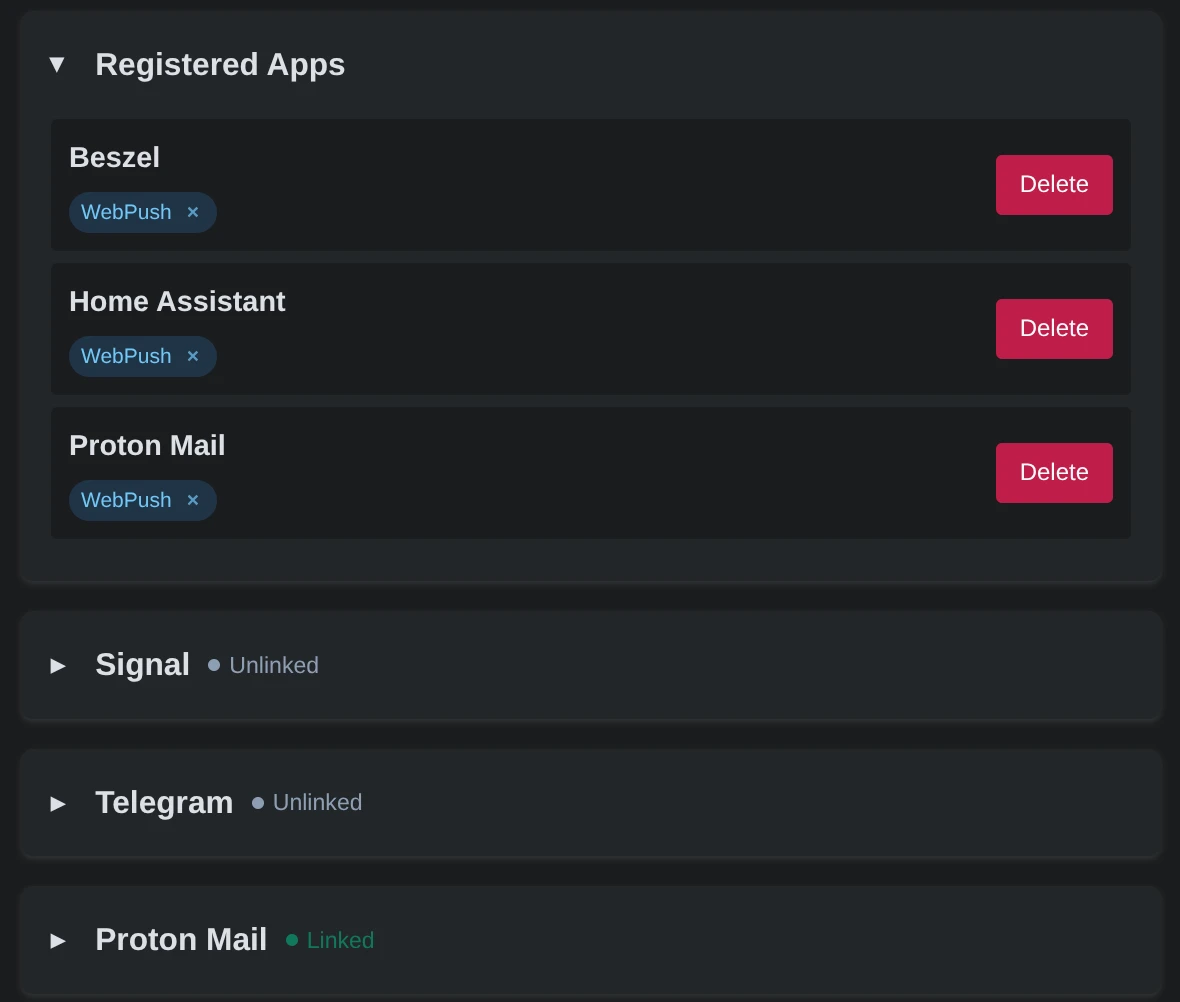
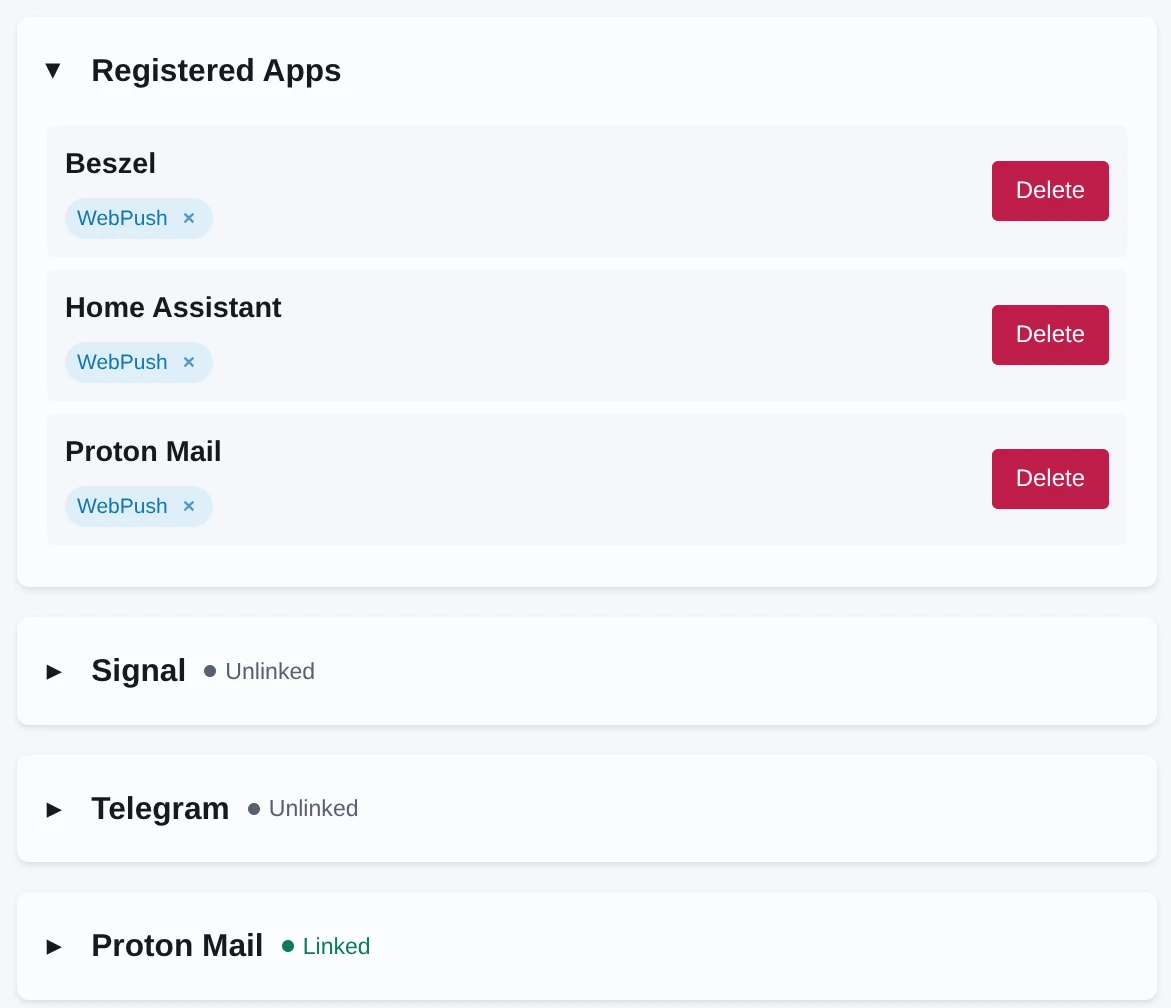
Prism Dashboard (light) Prism Dashboard (dark)

## Setup ### Docker (Recommended) ```bash curl -L -O https://raw.githubusercontent.com/lone-cloud/prism/master/.env.example mv .env.example .env nano .env # Set API_KEY=your-secret-key-here curl -L -O https://raw.githubusercontent.com/lone-cloud/prism/master/docker-compose.yml docker compose up -d ``` ### Binary (Alternative) ```bash curl -L -O https://github.com/lone-cloud/prism/releases/latest/download/prism-linux-amd64 chmod +x prism-linux-amd64 mv prism-linux-amd64 prism curl -L -O https://raw.githubusercontent.com/lone-cloud/prism/master/.env.example mv .env.example .env nano .env # Set API_KEY=your-secret-key-here ./prism ``` Prism is now running at . ## Integrations All integrations are configured through the web UI. Authenticate with your `API_KEY` as the password (username can be anything). ### Signal Send notifications through Signal Messenger. **Setup:** 1. Visit and authenticate with your API_KEY 2. Expand the Signal integration card 3. Click "Link Device" 4. Scan the QR code with Signal on your phone: - Open Signal → Settings → Linked Devices → Link New Device - Scan the displayed QR code 5. Your device will link automatically > **Note:** Binary installs require [signal-cli](https://github.com/AsamK/signal-cli/releases) in your PATH. Docker includes it automatically. ### Telegram Send notifications through a Telegram bot. **Setup:** 1. Create a bot: - Message [@BotFather](https://t.me/BotFather) on Telegram - Send `/newbot` and follow the prompts - Copy the bot token 2. Get your Chat ID: - Message [@userinfobot](https://t.me/userinfobot) on Telegram - Copy your Chat ID from the response 3. Configure in Prism: - Visit and authenticate with your API_KEY - Expand the Telegram integration card - Enter your bot token and chat ID - Click "Configure" ### Proton Mail Monitor a Proton Mail account and forward new emails as notifications through Signal or Telegram. **Setup:** 1. Visit and authenticate with your API_KEY 2. Configure Signal or Telegram first (required for routing) 3. Expand the Proton Mail integration card 4. Enter your Proton Mail credentials: - Email address - Password - 2FA code (if enabled) 5. Click "Link" New emails appear as notifications from the "Proton Mail" app. Credentials are encrypted (AES-256-GCM) and tokens refresh automatically. ### WebPush Send notifications directly to your browser. **Setup:** 1. Visit and authenticate with your API_KEY 2. Allow browser notifications when prompted 3. Apps without Signal or Telegram configured will automatically use WebPush ## API All API endpoints require authentication with your API key: ```bash Authorization: Bearer YOUR_API_KEY ``` ### ntfy-compatible publish API Publish notifications to `POST /{appName}`. `{appName}` is the target app/topic name. Messages are routed to all subscriptions configured for that app (Signal, Telegram, WebPush). **JSON payload:** ```bash curl -X POST http://localhost:8080/my-app \ -H "Authorization: Bearer YOUR_API_KEY" \ -H "Content-Type: application/json" \ -d '{"title": "Alert", "message": "Something happened"}' ``` **Plain text payload:** ```bash curl -X POST http://localhost:8080/my-app \ -H "Authorization: Bearer YOUR_API_KEY" \ -d "Simple message text" ``` ### WebPush subscription API Register and remove WebPush subscriptions for an app. #### POST /api/v1/webpush/subscriptions Creates a WebPush subscription. Required fields: - `appName` - `pushEndpoint` Optional encrypted payload fields (must be provided together): - `p256dh` - `auth` - `vapidPrivateKey` ```bash curl -X POST http://localhost:8080/api/v1/webpush/subscriptions \ -H "Authorization: Bearer YOUR_API_KEY" \ -H "Content-Type: application/json" \ -d '{ "appName": "my-app", "pushEndpoint": "https://example.push.service/send/abc123", "p256dh": "BASE64URL_P256DH", "auth": "BASE64URL_AUTH", "vapidPrivateKey": "BASE64URL_VAPID_PRIVATE_KEY" }' ``` Minimal registration (without encrypted payload fields): ```bash curl -X POST http://localhost:8080/api/v1/webpush/subscriptions \ -H "Authorization: Bearer YOUR_API_KEY" \ -H "Content-Type: application/json" \ -d '{ "appName": "my-app", "pushEndpoint": "http://localhost:9001/mock-push" }' ``` #### DELETE /api/v1/webpush/subscriptions/{subscriptionId} Removes a WebPush subscription by ID. ```bash curl -X DELETE http://localhost:8080/api/v1/webpush/subscriptions/SUBSCRIPTION_ID \ -H "Authorization: Bearer YOUR_API_KEY" ``` ## Real-World Examples ### Home Assistant Add to `configuration.yaml`: ```yaml notify: - platform: rest name: Prism resource: "http:///Home Assistant" method: POST_JSON title_param_name: title headers: Authorization: !secret prism_api_key ``` Add to `secrets.yaml`: ```bash prism_api_key: "Bearer YOUR_API_KEY_HERE" ``` Then use the `notify.prism` action in automations. ### Beszel In [Beszel](https://beszel.dev)'s **Settings → Notifications**, add: ``` ntfy://:YOUR_API_KEY@:/Beszel?disableTLS=yes ``` `disableTLS=yes` is only needed for local HTTP. The app name (`Beszel`) can be anything. ## Monitoring ### Health Endpoints #### GET /health Public. Returns `200 OK` when running. ```bash curl http://localhost:8080/health ``` #### GET /api/v1/health Authenticated. Returns uptime and integration status: ```bash curl http://localhost:8080/api/v1/health \ -H "Authorization: Bearer YOUR_API_KEY" ``` ```json { "version": "1.2.0", "uptime": "2h15m", "signal": {"linked": true, "account": "+1234567890"}, "telegram": {"linked": true, "account": "123456789"}, "proton": {"linked": true, "account": "user@proton.me"} } ```